
Surrogacy has been an option for intended parents in Russia for several decades. The country developed a commercial surrogacy sector supported by fertility clinics, IVF specialists, and agencies that coordinate medical and legal arrangements. However, Russian surrogacy laws have changed significantly in recent years, particularly regarding access for foreign intended parents.
Important legal update: Since December 2022, foreign citizens and stateless persons have generally been prohibited from using surrogacy services in Russia. Eligibility is now restricted primarily to qualifying Russian citizens and certain mixed-nationality married couples. Anyone considering surrogacy in Russia should verify their eligibility under current legislation before making plans.
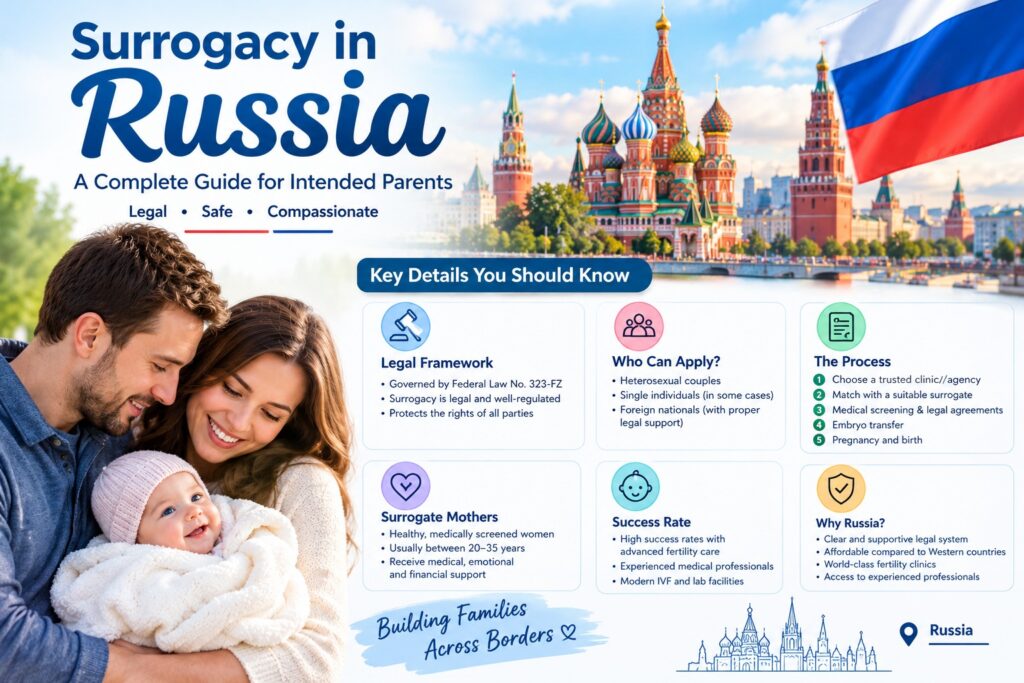
A Brief History of Surrogacy in Russia
Surrogacy has been practised in Russia since the 1990s. St. Petersburg and Moscow became important centres for assisted reproductive technology, including IVF and gestational surrogacy.
Federal Law No. 323-FZ, adopted in November 2011, established a statutory framework for assisted reproductive technologies and surrogacy. The law addressed medical eligibility, the role of surrogate mothers, and the procedures involved in establishing parentage.
Russia subsequently became known for permitting commercial surrogacy arrangements. However, Federal Law No. 538-FZ, adopted on 19 December 2022, introduced major restrictions on access for foreign intended parents. These changes significantly altered Russia’s position as a destination for international surrogacy.
Is Surrogacy Legal in Russia?
Yes. Both commercial and altruistic surrogacy remain legally possible in Russia, subject to applicable eligibility requirements and medical regulations. However, legal access is restricted, and foreign intended parents cannot assume that they are eligible to participate in a Russian surrogacy programme.
Under the amended legal framework:
- Russian married couples: May qualify if they meet the relevant medical, citizenship, and other legal requirements.
- Mixed-nationality married couples: May qualify where at least one spouse is a Russian citizen, subject to applicable requirements.
- Single Russian women: May qualify under the relevant legal and medical conditions.
- Foreign nationals: Generally cannot independently access Russian surrogacy services.
- Surrogate mothers: Must be Russian citizens and meet the applicable medical and statutory requirements.
The legal framework includes Federal Law No. 323-FZ, Article 55, as amended by Federal Law No. 538-FZ. The requirements for establishing legal parentage must also be considered when assessing an individual case.
Prospective parents should consult a Russian family-law specialist and a qualified fertility clinic before proceeding.
Requirements for Becoming a Surrogate Mother in Russia
Russian legislation sets eligibility requirements for women who wish to become surrogate mothers. The statutory framework generally includes the following conditions:
- The woman must be a Russian citizen.
- She must be between 20 and 35 years old.
- She must have at least one healthy child of her own.
- She must meet the applicable physical and medical health requirements.
- She must undergo the necessary medical examinations and provide informed consent.
Additional requirements may apply depending on the individual circumstances and current regulations. The medical clinic should confirm eligibility before treatment begins.
Gestational Surrogacy in Russia
Gestational surrogacy is the principal form of surrogacy used in Russian fertility programmes.
In this arrangement, an embryo created through in vitro fertilisation (IVF) is transferred into the surrogate mother’s uterus. The embryo may be created using the intended parents’ reproductive cells or donor eggs or sperm, where legally permitted.
The surrogate carries the pregnancy and gives birth, but she does not have a genetic connection to the child when the embryo is created using someone else’s egg.
A written surrogacy agreement is an important part of the arrangement. However, a contract alone does not automatically resolve every question relating to parental rights, birth registration, or consent. Russian law provides specific procedures for establishing parentage, including circumstances in which the surrogate mother’s consent is required.
Where Is Surrogacy Available in Russia?
Moscow and St. Petersburg have historically been major centres for fertility treatment and surrogacy services. Other cities, including Yekaterinburg and Kaliningrad, have also had fertility clinics offering reproductive medicine services.
The availability of a fertility clinic does not necessarily mean that every intended parent is eligible for surrogacy there. Prospective parents should confirm that the clinic is appropriately licensed and that its programme complies with current Russian legislation.
Cost of Surrogacy in Russia
Historical online estimates have placed Russian surrogacy programmes at approximately US$35,000–US$55,000. These figures should not be treated as verified current prices or as an offer available to foreign intended parents.
The total expense of a surrogacy arrangement may depend on:
- IVF treatment and embryo transfer
- Fertility medications and laboratory investigations
- Surrogate-related medical care and pregnancy monitoring
- Compensation and permitted pregnancy-related expenses
- Legal consultations and documentation
- Delivery and postnatal care
- Embryo freezing and storage, where required
- Additional treatment or complications
Costs can vary substantially between clinics and individual cases. Anyone researching prices should request a detailed written breakdown and confirm legal eligibility before paying an agency or clinic.
Egg Donation in Russia
Egg donation is another assisted reproductive option offered by fertility clinics in Russia, subject to applicable medical and legal requirements.
Egg donation may be considered when an intended mother cannot use her own eggs or when a fertility specialist recommends donor eggs for another medical reason. Depending on the programme, donors may be anonymous or identifiable under the applicable arrangements and rules.
Donors undergo medical screening to assess their suitability. Intended parents should confirm donor eligibility, consent procedures, screening protocols, and the legal terms of the programme directly with the clinic.
Egg donation and surrogacy are separate procedures, although they may be combined in some fertility treatment plans.
Step-by-Step Surrogacy Process in Russia
For intended parents who meet the current eligibility requirements, the process generally involves several stages. The precise steps may vary according to medical needs, clinic protocols, and legal circumstances.
Step 1: Initial Consultation
The intended parents consult a qualified fertility specialist to discuss their reproductive history, previous treatments, and medical reasons for considering surrogacy.
Step 2: Medical Assessment
The clinic arranges the necessary investigations, which may include blood tests, infectious-disease screening, semen analysis, ovarian assessment, and other fertility tests.
Step 3: Legal Eligibility Assessment
Before entering a programme, the intended parents should have their citizenship, marital status, medical indications, and eligibility reviewed by a Russian legal professional.
Step 4: Surrogate Matching
Once eligibility is confirmed, the clinic or authorised programme coordinator may facilitate matching with a medically suitable surrogate mother.
The intended parents should receive clear information about screening, consent, medical care, confidentiality, and the responsibilities of all parties.
Step 5: Agreement and Treatment Planning
The parties review the proposed surrogacy agreement and obtain independent legal advice where appropriate. The fertility specialist prepares the treatment plan, including the use of the intended parents’ or donors’ reproductive cells, if applicable.
Step 6: IVF and Embryo Transfer
The clinic performs IVF or the relevant assisted reproductive procedure. Following appropriate assessment, an embryo is transferred into the surrogate mother’s uterus.
Step 7: Pregnancy Monitoring
If pregnancy is confirmed, the surrogate receives antenatal care and regular medical monitoring. The intended parents should be informed about the agreed communication arrangements and medical updates, subject to privacy and consent requirements.
Step 8: Delivery and Legal Parentage
The surrogate gives birth at an appropriate medical facility. Birth registration and recognition of the intended parents must follow Russian law and the requirements applicable to the specific arrangement.
Step 9: Documentation and Travel
Where relevant, the intended parents must resolve citizenship, travel-document, and immigration requirements before travelling with the child. Foreign-national family members should seek advice from the relevant authorities in both countries.
Note: This outline describes the general stages of an eligible surrogacy arrangement. It is not a guarantee that a particular individual can access the programme or that every case follows the same sequence.
Legal and Practical Considerations for Intended Parents
Surrogacy involves medical, ethical, and legal responsibilities for everyone involved. Before proceeding, intended parents should pay particular attention to the following issues:
- Eligibility: Confirm that the intended parents and surrogate meet current legal requirements.
- Independent legal advice: Understand the agreement, parental rights, consent requirements, and dispute-resolution options.
- Medical standards: Verify the clinic’s credentials and the surrogate’s medical screening.
- Financial transparency: Request a complete breakdown of fees, exclusions, refunds, and additional expenses.
- Parentage and citizenship: Determine how birth registration and the child’s nationality will be handled.
- International travel: Obtain country-specific advice before assuming that a child can immediately travel abroad.
These precautions can help intended parents make informed decisions and better understand the responsibilities associated with surrogacy.
Conclusion
Russia has a long history of assisted reproductive medicine and commercial surrogacy. Nevertheless, its legal environment has changed substantially, particularly since the restrictions introduced in December 2022.
Although surrogacy remains legally possible for eligible individuals, Russia is no longer generally open to foreign intended parents seeking to use Russian surrogate mothers. Anyone considering treatment should verify current eligibility, medical requirements, and parentage procedures with qualified Russian legal and medical professionals before making a commitment.
Frequently Asked Questions
1. Is commercial surrogacy legal in Russia?
Commercial surrogacy remains legally possible under Russian law, subject to the applicable eligibility and medical requirements. Access is restricted for foreign intended parents.
2. Can foreign couples use a surrogate mother in Russia?
Generally, no. Since December 2022, foreign citizens and stateless persons have been prohibited from accessing surrogacy services in Russia. Certain mixed-nationality married couples may qualify if at least one spouse is a Russian citizen and the other legal requirements are met.
3. What is the minimum age for a surrogate mother in Russia?
The statutory age range generally begins at 20 and ends at 35. Citizenship, previous childbirth, health, and other eligibility requirements also apply.
4. How much does surrogacy cost in Russia?
Historical estimates range from approximately US$35,000 to US$55,000, but these figures are not verified current prices. The actual cost depends on the programme, treatment requirements, and permitted expenses.
5. Is gestational surrogacy permitted in Russia?
Yes. Gestational surrogacy is used in Russian assisted reproductive medicine, subject to applicable laws and eligibility requirements.
6. Can a single person pursue surrogacy in Russia?
The law permits certain single Russian women to access surrogacy under specific conditions. Eligibility is not the same for all single individuals, and foreign single intended parents should not assume they qualify.
7. What law governs surrogacy in Russia?
Important legislation includes Federal Law No. 323-FZ on the protection of citizens’ health, particularly Article 55, and Federal Law No. 538-FZ of 19 December 2022, which introduced significant restrictions.
References
- Federal Law No. 538-FZ — Russian surrogacy and citizenship amendments
- Article 55 of Federal Law No. 323-FZ — Assisted reproductive technologies
- The Economist — Russia’s liberal surrogacy rules are under threat
Disclaimer: This article is for general informational purposes and is not a substitute for legal, medical, or immigration advice. Laws and eligibility requirements can change; confirm the current position with qualified professionals before making decisions.

Ravi Sharma is a self-motivated, successful entrepreneur and has a solid experience in the fertility segment. and he is the director at ARTbaby Global (ARThealthcare). He is a pharmacy graduate with post-graduation in business administration and has 14 years of rich experience in the field of infertility segment. He loves to write about IVF, Surrogacy, and other ART (assisted reproductive technology) news, issues, and updates. He is a Pharmacy graduate (B. Pharm) and M.B.A (marketing).
His most recent success includes the successful launch of the medical tourism company, ARTbaby, which offers treatment options for infertility, egg donation, and surrogacy. He likes spending time with his family and writing about various aspects of IVF surrogacy and donating eggs.