
For many women facing infertility, a diagnosis of Diminished Ovarian Reserve (DOR) can feel overwhelming. Traditionally, fertility specialists focused heavily on the number of eggs remaining in the ovaries. However, fertility medicine in 2026 is shifting toward a more important concept: egg quality often matters more than egg quantity.
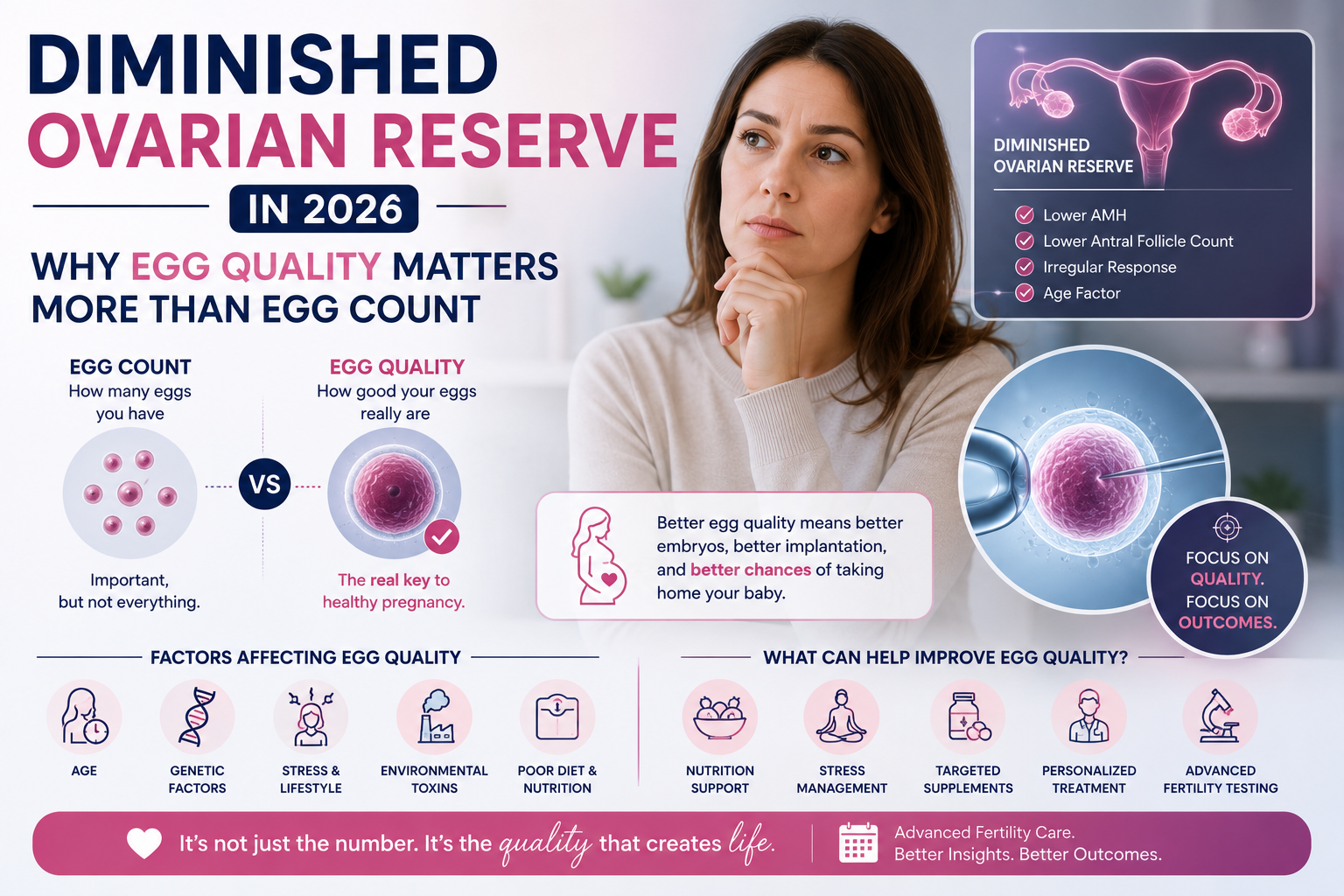
Advances in reproductive medicine, genetics, embryo assessment, and individualized fertility treatment have transformed how clinicians evaluate ovarian reserve. Women with fewer eggs can still achieve successful pregnancies when the available eggs are healthy and capable of producing viable embryos.
For intended parents exploring IVF or surrogacy in Georgia, understanding this distinction is essential when making informed fertility decisions.
What Is Diminished Ovarian Reserve?
Diminished ovarian reserve refers to a reduction in the number of eggs remaining in a woman’s ovaries compared with what is expected for her age.
Women are born with a finite number of eggs, and this reserve naturally declines over time. However, some women experience accelerated depletion due to:
- Advancing maternal age
- Genetic factors
- Endometriosis
- Ovarian surgery
- Autoimmune disorders
- Cancer treatments such as chemotherapy or radiation
- Environmental and lifestyle factors
DOR does not necessarily mean infertility. Rather, it indicates that fertility treatment may require a more personalized approach.
How Is Ovarian Reserve Evaluated?
Fertility specialists typically assess ovarian reserve through:
- Anti-Müllerian Hormone (AMH)
AMH is produced by developing ovarian follicles and provides an estimate of remaining egg supply.
- Antral Follicle Count (AFC)
Ultrasound imaging measures the number of small follicles present in the ovaries at the start of a menstrual cycle.
- Follicle-Stimulating Hormone (FSH)
Elevated FSH levels may indicate declining ovarian function.
While these tests estimate egg quantity, they cannot directly measure egg quality.
Why Egg Quality Matters More Than Egg Count
One of the most significant developments in reproductive medicine is the growing recognition that the ability of an egg to develop into a healthy embryo is often more important than the total number of eggs retrieved.
A woman may produce:
- Fifteen eggs with poor developmental potential, or
- Four eggs with excellent reproductive competence
In many cases, the second scenario offers a better chance of pregnancy.
Egg quality influences:
- Fertilization rates
- Embryo development
- Implantation success
- Miscarriage risk
- Live birth outcomes
This explains why some women with low ovarian reserve successfully conceive through IVF, while others with larger egg numbers may still face challenges.
Understanding Oocyte Competence
In 2026, fertility experts increasingly focus on oocyte competence, which refers to an egg’s ability to:
- Mature properly
- Fertilize successfully
- Support embryo development
- Lead to a healthy pregnancy
Research suggests that ovarian reserve markers alone cannot fully predict reproductive outcomes.
Instead, clinicians evaluate multiple factors, including:
- Maternal age
- Genetic health
- Embryo quality
- Previous IVF outcomes
- Overall reproductive health
This broader assessment provides a more realistic picture of fertility potential.
New Advances in IVF for Women with DOR
Modern IVF strategies are helping improve outcomes for women with diminished ovarian reserve.
Individualized Ovarian Stimulation
Instead of applying the same protocol to every patient, fertility specialists customize medication doses based on:
- Age
- AMH levels
- Previous cycle responses
- Hormonal profile
Advanced Embryo Culture Systems
Modern embryology laboratories use sophisticated incubation systems that provide optimal conditions for embryo development.
Genetic Testing
Preimplantation Genetic Testing (PGT) may help identify chromosomally normal embryos, improving implantation potential and reducing miscarriage risk in selected patients.
Freeze-All Strategies
Embryos can be cryopreserved and transferred later when the uterine environment is most favorable.
When Egg Donation May Be Considered
While many women with DOR can achieve pregnancy using their own eggs, some may experience repeated IVF failures or extremely low ovarian reserve.
In such situations, donor egg IVF may provide significantly higher success rates.
Egg donation may be recommended when:
- Ovarian reserve is severely depleted
- Multiple IVF cycles have failed
- Genetic concerns are present
- Maternal age substantially affects egg quality
Georgia has become a recognized destination for donor egg programs due to its experienced fertility centers, transparent processes, and international patient support.
The Role of Surrogacy in Fertility Treatment
Diminished ovarian reserve itself does not automatically require surrogacy.
However, surrogacy may become an option when DOR is accompanied by:
- Recurrent implantation failure
- Severe uterine abnormalities
- Repeated pregnancy loss
- Medical conditions that make pregnancy unsafe
For intended parents pursuing family building internationally, Georgia offers a structured framework for gestational surrogacy, combined with modern IVF services and experienced reproductive specialists.
Why International Patients Consider Georgia
Georgia continues to attract intended parents from around the world because of several advantages:
- Established fertility infrastructure
- Modern IVF laboratories
- Availability of donor egg programs
- Comprehensive patient coordination
- Transparent treatment planning
- Cost-effective fertility care compared with many Western countries
The capital city of Tbilisi has emerged as a leading reproductive medicine hub, serving patients from Europe, Asia, the Middle East, and beyond.
Lifestyle Factors That Support Egg Health
Although age remains the strongest determinant of egg quality, certain lifestyle habits may support overall reproductive health:
Consider:
- Maintaining a healthy weight
- Following a balanced Mediterranean-style diet
- Avoiding tobacco use
- Limiting alcohol consumption
- Managing chronic stress
- Prioritizing adequate sleep
- Treating underlying medical conditions promptly
These measures cannot reverse ovarian aging but may contribute to better fertility outcomes.
Frequently Asked Questions
Can I get pregnant naturally with diminished ovarian reserve?
Yes. Many women with DOR conceive naturally, particularly when egg quality remains good and ovulation occurs regularly.
Does low AMH mean poor egg quality?
Not necessarily. AMH primarily reflects egg quantity, not egg quality.
Can IVF help women with low ovarian reserve?
Yes. Modern IVF protocols are increasingly tailored to women with DOR and may improve pregnancy chances.
Is egg donation my only option?
No. Many women with diminished ovarian reserve successfully conceive using their own eggs before considering donor eggs.
Can surrogacy help women with DOR?
Surrogacy may be appropriate when ovarian reserve issues are combined with uterine or medical factors that prevent carrying a pregnancy.
References:
- https://www.sciencedirect.com/science/article/pii/S0015028220326236
Final Thoughts
The conversation around diminished ovarian reserve is changing rapidly. In 2026, fertility specialists are moving beyond simple egg counts and focusing on what truly matters: the ability of an egg to create a healthy embryo and successful pregnancy.
A low ovarian reserve does not automatically mean the end of fertility possibilities. Through individualized IVF protocols, advanced embryo assessment, donor egg programs, and, when necessary, gestational surrogacy, many intended parents continue to achieve their dream of parenthood.
At Surrogacy Centre Georgia, intended parents receive guidance on fertility treatment pathways, donor programs, and surrogacy options designed to support informed decision-making and personalized family-building journeys.

Ravi Sharma is a self-motivated, successful entrepreneur and has a solid experience in the fertility segment. and he is the director at ARTbaby Global (ARThealthcare). He is a pharmacy graduate with post-graduation in business administration and has 14 years of rich experience in the field of infertility segment. He loves to write about IVF, Surrogacy, and other ART (assisted reproductive technology) news, issues, and updates. He is a Pharmacy graduate (B. Pharm) and M.B.A (marketing).
His most recent success includes the successful launch of the medical tourism company, ARTbaby, which offers treatment options for infertility, egg donation, and surrogacy. He likes spending time with his family and writing about various aspects of IVF surrogacy and donating eggs.